
What Is Business Downtime?
In today’s technology-driven world, uptime is no longer a luxury, it’s a necessity. Businesses rely on digital systems for everything from processing transactions and communicating with customers to managing inventory and accessing critical data.
IT downtime occurs whenever a technology system, network, application, server, or other critical resource becomes unavailable and prevents normal business operations.
Sometimes downtime affects an entire organization. Other times, it may affect a single department, application, office, or group of employees. Either way, the impact can extend far beyond temporary frustration.
Downtime can affect:
- Your financial bottom line
- Employee productivity
- Customer relationships
- Your business’s reputation
- Data availability
- Regulatory and compliance obligations
Whether it’s caused by a server crash, cyberattack, network failure, software issue, or power outage, every minute offline can have consequences. Lost revenue, missed opportunities, recovery expenses, and loss of customer trust can quickly turn a technical issue into a business problem.
Understanding the full scope of downtime, and what it truly costs your business, is the first step toward protecting your operations and improving long-term resilience.
How Much Does IT Downtime Cost a Business?
There isn’t one universal cost of IT downtime. The financial impact depends on the size of your organization, how many employees are affected, how dependent your operations are on technology, how long the outage lasts, and which systems become unavailable.
When calculating the cost of downtime, businesses should consider more than lost sales.
A basic calculation might look like:
Cost of Downtime = Lost Revenue + Lost Productivity + Recovery Costs + Additional Business Impact
For example, imagine an outage prevents 20 employees from working for three hours. If the average cost of employee time is $40 per hour:
20 employees × $40 × 3 hours = $2,400 in lost productivity
And that’s before considering lost sales, IT recovery expenses, missed deadlines, customer impact, or other consequences.
This is why even a relatively short outage can become expensive.
What Causes IT Downtime?
Downtime doesn’t have a single cause. It can result from problems throughout your technology environment, which is why preventing outages requires looking beyond individual computers or applications.
Common causes of IT downtime include:
-Hardware Failure
Servers, storage devices, networking equipment, workstations, and other hardware can eventually fail. Aging or poorly maintained equipment can increase the likelihood of unexpected disruptions.
-Network and Connectivity Problems
Internet outages, network configuration problems, failed switches, firewalls, and other connectivity issues can prevent employees from accessing applications, files, cloud platforms, and other resources.
-Cybersecurity Incidents
Ransomware, malware, compromised accounts, and other cyberattacks can force systems offline or require businesses to isolate affected technology while an incident is investigated.
-Human Error
Accidental deletions, incorrect configurations, improper system changes, and other mistakes can result in outages even when the underlying technology is functioning properly
-Software and Update Issues
Application failures, incompatible updates, expired licenses, and poorly executed system changes can cause unexpected interruptions.
-Power Outages and External Events
Power failures, severe weather, internet service disruptions, and other events outside of your organization’s control can also affect technology availability.
Understanding where your biggest vulnerabilities exist makes it easier to develop a plan for reducing downtime.
Although downtime can’t always be prevented, businesses can implement the right systems and standards to significantly lower the risk and mitigate its impact when it does happen
1. Your Financial Bottom Line
IT downtime is one of the most financially disruptive technology risks a business can face. When critical systems go down, operations may slow or stop entirely while normal expenses continue.
Lost sales are only one component of the total cost. Businesses may also encounter emergency IT expenses, hardware replacement costs, data restoration expenses, overtime, contractual penalties, and other unexpected costs associated with recovering from an outage.
For organizations that generate revenue directly through digital systems, even relatively short outages can interfere with transactions and customer activity.
Simply put, downtime doesn’t just pause your business, it can directly affect your bottom line.
2. Employee Productivity
Downtime can bring productivity to a halt when employees can’t access the tools, systems, applications, or data required to do their jobs.
Even if an outage only affects part of your environment, employees may spend time waiting for systems to return, attempting workarounds, contacting support, or completing tasks manually.
This can lead to lost work hours, delayed projects, missed deadlines, and inefficiencies that continue after the initial problem has been resolved.
3. Recovery and Remediation Costs
Getting systems operational again can create costs of its own.
Depending on the cause and severity of the outage, recovery may require:
- Emergency technical support
- Replacement hardware
- Data restoration
- Cybersecurity investigation
- Software repair or reconfiguration
- Employee overtime
- Third-party specialists
- Additional security measures
The longer an outage continues, the more resources may be required to diagnose the problem and restore normal operations.
4. Customer Relationships
Downtime has the potential to seriously impact the customer experience. If customers can’t contact your business, access services, place orders, receive information, or get the assistance they need, frustration can quickly develop.
For businesses where availability is particularly important, repeated outages can eventually cause customers to look for more reliable alternatives.
5. Business Reputation
Technology problems aren’t always invisible to customers.
Repeated outages, missed deadlines, communication problems, unavailable services, or security incidents can create the perception that a business is unreliable.
While systems may be restored within hours, rebuilding customer confidence can take considerably longer.
For businesses where availability is particularly important, repeated outages can eventually cause customers to look for more reliable alternatives.
6. Compliance and Data Risk
For businesses operating under regulatory or contractual requirements, certain outages can create additional concerns.
If downtime affects access to protected information, backups, security systems, records, or required business processes, an organization may need to determine whether the incident creates reporting, contractual, or compliance obligations.
This makes business continuity particularly important for organizations operating in regulated industries.
Reducing the Risk of IT Downtime
Although downtime can’t always be prevented, businesses can implement the right systems and standards to significantly lower the risk and mitigate its impact when it does happen
While internal teams play an important role in daily operations, keeping downtime to a minimum often requires consistent monitoring, maintenance, planning, and technical expertise.
A managed IT provider can help monitor your environment, maintain critical systems, address vulnerabilities, troubleshoot issues, and respond when something goes wrong.
IT professionals can help with:
- Faster issue resolution
- Proactive monitoring
- Preventative maintenance
- System and network management
- Cybersecurity
- Backup and recovery planning
- Technology lifecycle planning
- Scalable technical support
1. Partner With IT Experts
2. Train Employees
Technology may power your business, but employees interact with that technology every day.
Human error can contribute to downtime through accidental file deletion, configuration mistakes, improper system use, phishing attacks, compromised credentials, and other incidents.
Training shouldn’t only teach employees how to use their tools. It should also help create a culture of security awareness and responsible technology use.
Training can include:
- How to identify and report technical problems quickly
- Best practices for using business systems
- Cybersecurity awareness
- Phishing identification
- Password and account security
- Backup and data-handling procedures
- Understanding your organization’s incident and recovery procedures
3. Invest in Reliable Infrastructure
At the heart of every business operation is its technology infrastructure. The servers, networks, devices, applications, and cloud platforms that keep everything running.
When infrastructure is outdated, misconfigured, unsupported, or poorly maintained, it can become a significant source of downtime risk.
Investing in reliable infrastructure and maintaining it properly can help:
- Prevent unexpected system failures
- Improve speed and performance
- Support remote and hybrid employees
- Improve network reliability
- Strengthen security
- Support future business growth
However, purchasing new equipment isn’t enough. Servers, networks, and other critical systems require ongoing monitoring, maintenance, updates, and lifecycle planning.
4. Maintain Reliable Backups
Backups are critical when downtime involves lost, corrupted, encrypted, or inaccessible data.
A strong backup strategy should consider what data needs to be protected, how frequently backups occur, where backup copies are stored, and how quickly information can be restored following an incident.
Just as importantly, businesses should verify that backups are functioning correctly rather than discovering a problem when they actually need to restore data.
5. Keep Systems Updated and Maintained
Backups are critical when downtime involves lost, corrupted, encrypted, or inaccessible data.
A strong backup strategy should consider what data needs to be protected, how frequently backups occur, where backup copies are stored, and how quickly information can be restored following an incident.
Just as importantly, businesses should verify that backups are functioning correctly rather than discovering a problem when they actually need to restore data.
6. Have a Business Continuity and Recovery Plan
Outdated operating systems, applications, firmware, and other technology can create both reliability and security problems.
Regular patching and preventative maintenance can help address known vulnerabilities, improve system stability, and reduce the likelihood that neglected technology contributes to an outage.
Businesses should also monitor the lifecycle of critical equipment so aging hardware can be replaced strategically rather than only after it fails.
How Managed IT Can Help Reduce Downtime
Reducing downtime isn’t about eliminating every possible technology problem. It’s about identifying risks early, maintaining critical systems, preparing for failures, and responding quickly when problems occur.
A proactive managed IT strategy brings together monitoring, maintenance, cybersecurity, backups, employee support, and technology planning rather than treating each problem independently.
This can help businesses identify warning signs earlier, maintain a healthier IT environment, and build a recovery strategy for situations where downtime does occur.
In Conclusion
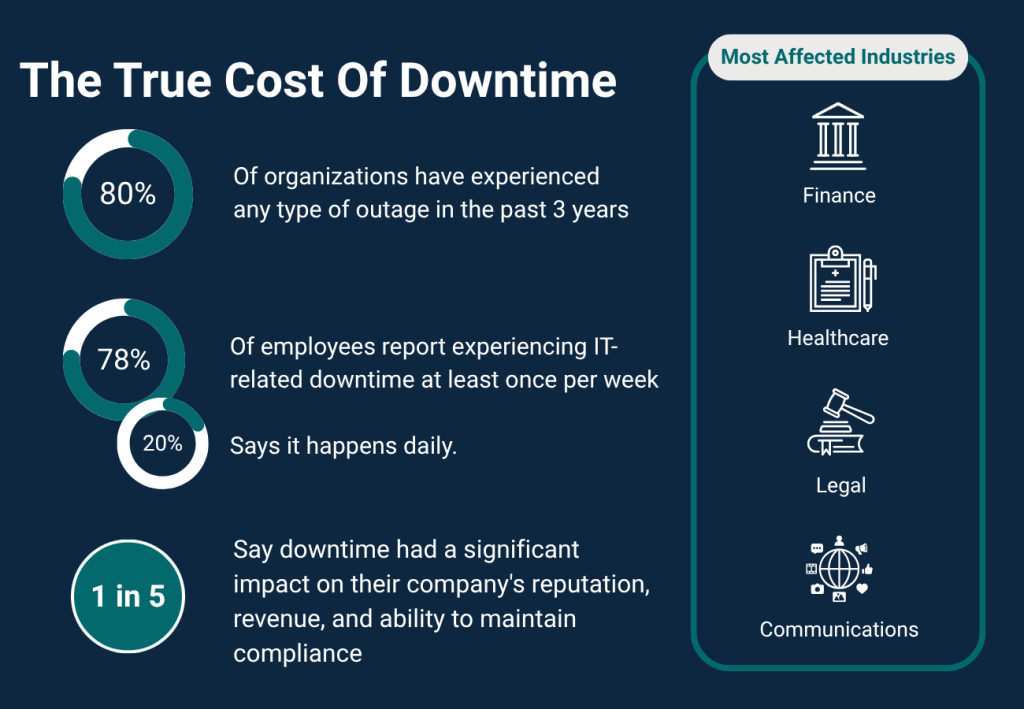
The true cost of IT downtime extends far beyond the minutes or hours that a system is unavailable. Lost productivity, revenue disruption, recovery expenses, customer frustration, security concerns, and reputational damage can all contribute to the overall impact of an outage.
While downtime can’t always be avoided, businesses can reduce their exposure by maintaining reliable infrastructure, training employees, protecting critical data, keeping technology updated, and preparing for unexpected disruptions.
Taking a proactive approach to technology doesn’t just help prevent outages, it can also help your business recover faster when something does go wrong.