
Managed IT vs. Break/Fix IT: Which Is Better for Your Business?
Every business depends on technology, but not every business manages it the same way. When it comes to IT support, there are two common approaches: Managed IT Services and Break/Fix IT. When comparing managed IT vs. break/fix IT, it’s important to understand that each model takes a different approach to managing your business technology.
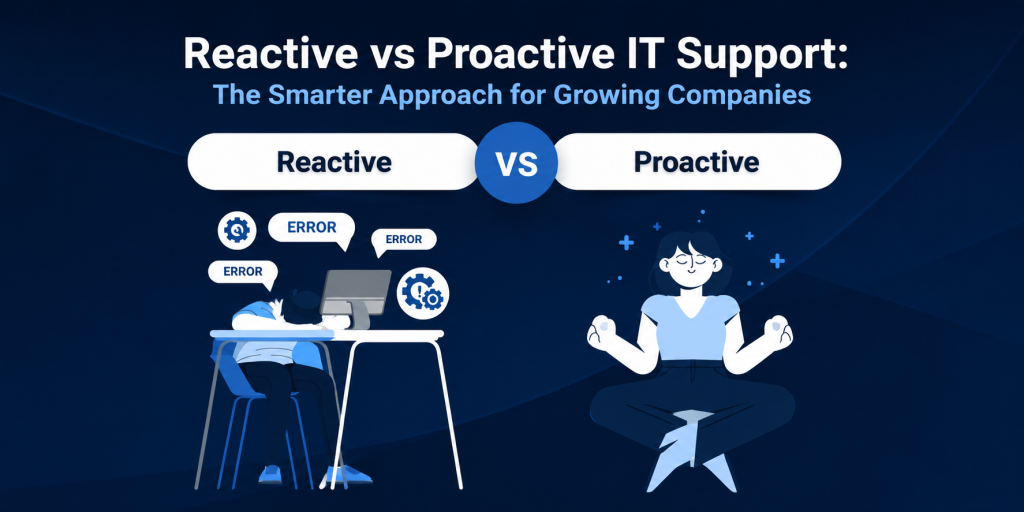
While both are designed to keep your business running, the way they do it couldn’t be more different. Managed IT focuses on preventing problems before they occur, while Break/Fix IT responds only after something has already gone wrong.
Understanding these differences can help you choose the IT support model that best aligns with your business goals, budget, and long-term technology needs.
Understanding Break/Fix IT?
Break/fix IT is the traditional model of IT support.
Instead of paying a monthly fee for ongoing IT management, businesses contact an IT provider only when they experience a problem.
For example, you might call an IT company if:
- A server crashes
- The office internet goes down
- A computer won’t start
- Email stops working
- A printer won’t connect
Once the issue is resolved, the work is complete, and you pay for the time and services provided.
For some very small businesses with minimal technology needs, this model can seem cost-effective. However, it often results in unexpected expenses and extended downtime when problems occur.
What Are Managed IT Services?
Managed IT Services take a proactive approach to technology management.
Instead of waiting for something to fail, a Managed Service Provider (MSP) continuously monitors, maintains, and secures your technology environment. Regular maintenance, software updates, cybersecurity monitoring, backups, and help desk support all work together to reduce the likelihood of major disruptions.
The goal is simple: prevent issues before they impact your business.
Managed IT vs. Break/Fix IT: The Key Differences
The biggest difference between managed IT and break/fix IT is that one focuses on prevention while the other focuses on repair.
| Managed IT | Break/Fix IT |
|---|---|
| Proactive support | Reactive support |
| Monthly predictable pricing | Pay when something breaks |
| Continuous monitoring | No ongoing monitoring |
| Preventative maintenance | Repairs after failure |
| Built-in cybersecurity | Often additional services |
| Regular updates and patching | Updates only when requested |
| Strategic IT planning | Limited long-term planning |
| Focused on preventing downtime | Focused on fixing downtime |
1. Proactive vs. Reactive Support
The biggest difference between these models is how problems are handled.
With managed IT, your provider is actively looking for potential issues before they become major problems. Routine maintenance, monitoring, and updates help prevent disruptions.
Break/fix IT is reactive. The provider becomes involved only after something has already stopped working.
For businesses that rely on technology every day, preventing problems is often far less expensive than recovering from them.
2. Predictable Costs vs. Unexpected Bills
Budgeting for IT can be difficult when you never know when something might fail.
Managed IT typically provides predictable monthly pricing, making it easier to forecast technology expenses.
With break/fix support, costs can vary significantly depending on the severity of the issue. A major server failure or cybersecurity incident can result in expensive emergency repairs and lost productivity.
3. Downtime
Technology issues don’t just affect computers, they affect your employees, customers, and revenue.
With proactive monitoring, many issues can be detected and resolved before employees even notice them.
Under the break/fix model, downtime often lasts until someone reports the problem and a technician is available to diagnose and repair it.
Every hour of downtime can impact productivity, customer service, and business operations.
Cybersecurity has become one of the biggest reasons businesses move away from break/fix support.
Managed IT providers typically include services such as:
- Endpoint protection
- Multi-factor authentication
- Email security
- Firewall management
- Security awareness training
- Vulnerability management
- Backup monitoring
With break/fix IT, security improvements are often performed only when requested or after an incident has already occurred.
5. Long-Term Technology Planning
Technology should support your business goals, not hold them back.
A quality managed IT provider helps businesses:
- Plan hardware replacements
- Budget for technology upgrades
- Improve cybersecurity
- Support business growth
- Adopt new technologies
Break/fix providers typically focus only on resolving the issue at hand without providing long-term strategic guidance.
Which Businesses Benefit Most from Managed IT?
Managed IT is often the better choice for businesses that:
- Depend on technology every day
- Have 10 or more employees
- Handle sensitive customer information
- Need stronger cybersecurity
- Want predictable IT costs
- Operate in regulated industries
- Support remote or hybrid employees
For organizations where uptime and security are essential, proactive IT management can reduce risk while improving productivity.
Is Break/Fix IT Ever the Right Choice?
In some cases, yes.
Very small businesses with only a few computers and limited reliance on technology may find break/fix support sufficient for their needs.
However, as businesses grow, technology becomes more complex. Unexpected downtime, cybersecurity threats, and increasing compliance requirements often make proactive IT management the more practical long-term solution.
Managed IT vs. Break/Fix IT: Which Is Right for Your Business?
There isn’t a one-size-fits-all answer.
If your business relies heavily on technology, values predictable costs, wants stronger cybersecurity, and prefers preventing problems instead of reacting to them, managed IT is generally the better investment.
If your technology needs are minimal and occasional downtime isn’t a major concern, break/fix support may still be an option.
The key is choosing the approach that aligns with your business goals, risk tolerance, and future growth plans.
Final Thoughts
Technology is one of your business’s most valuable assets. Choosing how it’s managed can affect productivity, security, and your bottom line for years to come.
By understanding the differences between managed IT and break/fix support, you can make a more informed decision about which model best fits your organization.
If you’re looking for proactive support that helps reduce downtime, improve cybersecurity, and provide predictable IT costs, our Managed IT Services can help your business stay productive and secure.